League Dominator
- 4.1
- Rating
- 10.00K
- Installs
- Free
- Price

 Analysis by App-foxy
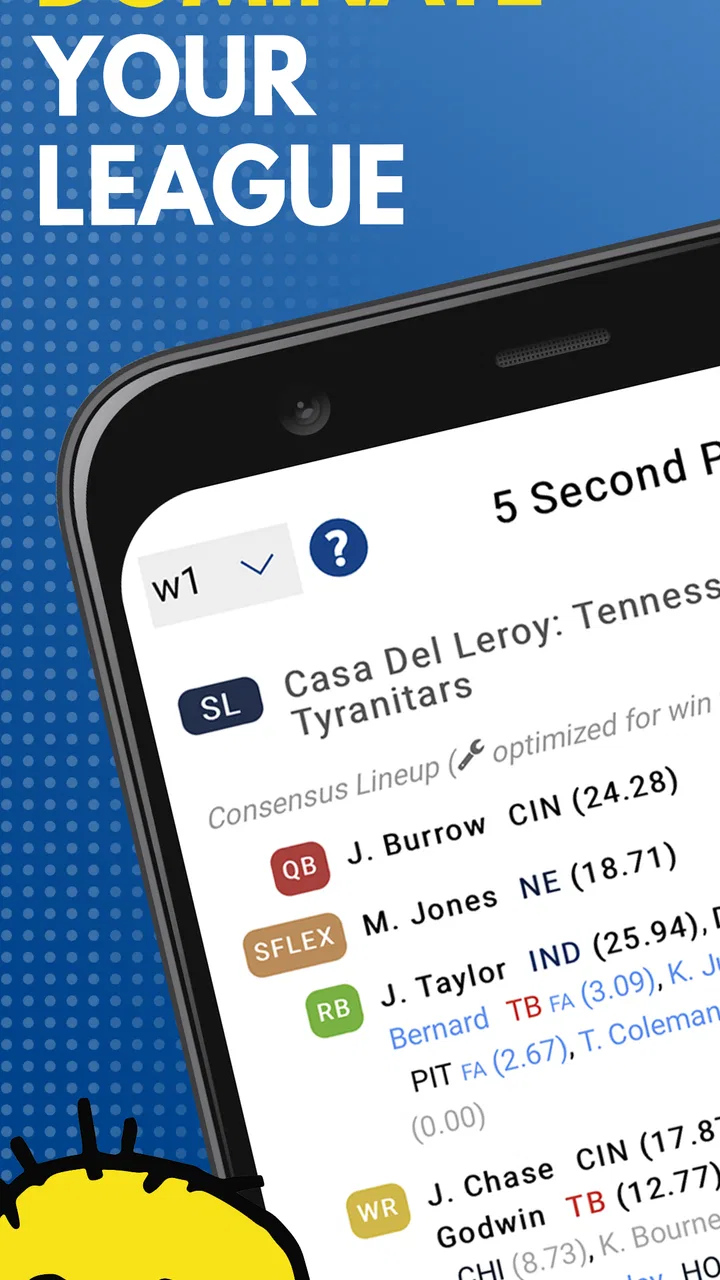
Fantasy football decisions are rarely difficult because there are no options. They are difficult because there are too many of them, and because the best move depends on your league, your roster, and the time you have before a deadline. League Dominator takes a focused approach to that problem. It is a free sports app from Footballguys built around helping you manage your own fantasy league rather than simply following football news.
I found it most useful as a decision aid. It does not replace your judgment, and it is not the kind of app I would open just to browse casually. Its value appears when I already have a lineup question, a trade to consider, or a roster spot that needs attention. The app gives that moment more structure, which is why it can appeal to managers who want practical guidance without maintaining a spreadsheet of every player and matchup.
There is also an important distinction between the free download and the complete experience. The app is free to install, while optional in-app purchases range from around thirteen dollars to nearly ninety dollars per item. That makes the right question less “Is it free?” and more “Will the extra tools save me enough time or improve enough decisions to justify paying?” My answer depends heavily on how seriously you play and how often you need help.
You May Also Like

 AccuWeather: Weather Radar
AccuWeather Review: A Quick, Clear Forecast for Everyday Decisions
For everyday plans, the best forecast is the one you can understand quickly. AccuWeather makes rain timing, radar, and local conditions easy to act on, with a few trade-offs.

 Hill Climb Racing
Why Hill Climb Racing Still Turns Crashes Into One More Run
A tiny car, a bumpy hill and one more upgrade: Hill Climb Racing keeps resurfacing because its simple chaos makes every near-miss feel personal.

 AliExpress - Shopping App
AliExpress Makes Global Shopping Feel Personal, but Shoppers Bear the Risk
AliExpress turns a global marketplace into a pocket-sized discovery engine. Its reach is useful, its shopping loop compelling, and its trade-offs easy to miss.

 Lords Mobile: Kingdom Wars
Lords Mobile Is a Kingdom-Building Routine, Not a Quick Match
A case-by-case verdict on the building, battles, device demands, and social commitments that make Lords Mobile rewarding for some players and exhausting for others.

 PDF Scanner app - TapScanner
TapScanner Makes Paperwork Easier to Capture, Check, and Share
TapScanner makes scanning with a phone feel less like a rescue operation and more like a dependable step in getting work done. Its capture tools are useful, though not flawless.

 Block Blast!
 Shows How Much a Puzzle Game Can Leave Out
A quiet grid game shows why puzzle players increasingly value instant clarity, repeatable skill and low-pressure play—and where the genre still needs to catch up.
More From Our News Desk
View All News


What I looked for before trusting it with league decisions
When I assess a fantasy football tool, I care about more than the number of features on its screen. I want to know whether it helps me make a decision quickly, whether its advice can be adapted to my league, and whether it encourages thoughtful roster management instead of handing me a supposedly perfect answer. League Dominator makes sense when those are your priorities.
The first useful test is a familiar weekly situation. Imagine it is the evening before your lineup locks. One of your starters has a questionable status, your bench has two plausible replacements, and a waiver option looks tempting. A general sports app may give you news and a fantasy platform may let you change the lineup, but neither necessarily helps you compare the decision in a way that fits your roster. This is where a dedicated league-management companion has a clearer purpose.
I also consider how much manual work an app creates. If I have to copy league settings, rebuild scoring rules, or enter every roster by hand, the initial setup can outweigh the benefit. On the other hand, a tool that understands the shape of my league can be more useful than a broad rankings page. The practical trade-off is simple: the more tailored the recommendation, the more carefully I need to configure and review it.
Another criterion is timing. Fantasy advice is only valuable while I can act on it. A detailed analysis that takes too long to interpret is less helpful during a Sunday morning lineup rush than a concise comparison that highlights the important risk. I therefore judge this app by the quality of the decision process it supports, not by whether every screen looks impressive.
Who will get the most from it
I would point competitive redraft managers toward League Dominator first. It is especially suitable for someone who enjoys making trades, checking waiver possibilities, and adjusting a roster throughout the season. A manager who already knows basic fantasy football will probably understand the app’s purpose quickly and get more from its recommendations.
It can also help a busy player who does not want to spend an hour reading several sources before making one move. The app gives that person a place to organize the question: keep the player, seek a trade, add a replacement, or change the weekly lineup. That does not eliminate research, but it can reduce the scattered feeling that often comes from comparing unrelated rankings and opinions.
Beginners may appreciate the direction, although I would not use it as a substitute for learning the fundamentals. If you do not understand positional scarcity, injury risk, schedule context, or the difference between a safe starter and a high-upside option, any recommendation can look more certain than it really is. I would use the app to ask better questions, not to stop thinking.
Where its focused approach is stronger
The strongest part of League Dominator is its league-first mindset. Many fantasy products are built around a larger ecosystem: live scoring, news feeds, social features, draft rooms, or a platform where the league itself is hosted. Those are useful, but they can make decision support feel like a secondary feature. This app is more appealing when the main task is improving the choices inside an existing league.
That focus changes how I use it. Instead of opening a general football feed and hoping an idea appears, I start with a specific roster problem. I might compare a player I am considering acquiring with the assets I would have to give up, or examine whether a waiver addition is genuinely better than the player already on my bench. The app becomes a filter for decisions rather than another stream of information.
A less obvious benefit is that it can expose the cost of a move. Fantasy managers often focus on the player they want and overlook the roster slot, future flexibility, or depth they are surrendering. A league-oriented workflow encourages me to assess the whole transaction. That is valuable in deeper leagues, where a seemingly minor bench move can matter several weeks later.
I also like using it as a pre-decision checklist. Before accepting a trade, I can pause and ask whether the move solves a real weakness, whether it creates a new one, and whether the improvement is large enough to justify the risk. Even when I disagree with an app’s conclusion, the process can reveal that my original idea was based on a recent performance streak rather than a durable roster need.
Three workflows that make it more useful
My first recommended workflow is to separate “information gathering” from “decision making.” I read injury updates and relevant football news elsewhere when necessary, then use League Dominator to evaluate what those facts mean for my roster. This prevents me from treating the app as a complete news source and keeps its role clear: translating context into a league decision.
The second is to test a move against more than one objective. For example, a trade may improve my starting lineup but weaken my bench, or help this week while making the next few weeks harder. I would examine the move from the perspective of immediate points, roster depth, and flexibility. That extra pass is a concrete way to avoid accepting advice that looks attractive only under one narrow assumption.
The third is to use it before urgency arrives. On a deadline day, I am more likely to accept the first reasonable option because I feel rushed. Reviewing my roster earlier gives me time to identify positions that need attention and possible alternatives. Then, when news changes, I am adjusting a plan instead of inventing one under pressure.
These habits are not flashy features, but they are where I see the app’s practical value. A fantasy tool can provide plenty of analysis and still fail if it does not improve the manager’s process. League Dominator works best when I use it to slow down the important choices while keeping the final decision in my hands.
Where another type of fantasy app may fit better
League Dominator is not automatically the best choice for every fantasy football manager. If your main need is live scoring, league chat, draft hosting, or a single place for breaking news, the platform where your league is hosted may be more convenient. Adding a separate decision tool creates another app to open and another workflow to maintain.
I would also hesitate to recommend it to someone who plays very casually and changes a lineup only occasionally. The app’s value grows with the number and importance of decisions you make. If you set a lineup on opening day and rarely revisit it, a simpler rankings page or the basic tools already included with your fantasy platform may be enough.
There is a similar issue for managers who prefer to build their own models. If you already track projections, matchups, player trends, and roster values in a personal spreadsheet, a specialized app may feel restrictive rather than helpful. You may prefer complete control over the assumptions. League Dominator is better for reducing decision friction than for replacing a customized analytical system.
Another alternative category is the broad fantasy suite. Those products can be more attractive if you want everything connected: draft preparation, league administration, scoring, news, and lineup management. The trade-off is that their advice may feel less centered on the exact decision you are trying to make. I would choose the broader suite for convenience and the focused app for more deliberate roster analysis.
There is no reason to treat these categories as mutually exclusive. I can use my league host for transactions and live updates, a news source for late information, and League Dominator for evaluating moves. That arrangement is less tidy than a single-app solution, but it may be more effective for an active manager. The important question is whether the additional step produces better decisions or merely adds another notification stream.
Limits I noticed in the overall experience
The biggest source of friction is the need to understand what the app is trying to do. Someone expecting a simple list of universally correct player rankings may be disappointed. Fantasy decisions depend on league rules and team context, so the user has to engage with the recommendations rather than passively consume them. That is a strength for careful managers, but a barrier for people seeking instant answers.
I would also be cautious about treating any recommendation as permanent. Injuries, role changes, weather, opponent adjustments, and league activity can change the situation quickly. The app can help me evaluate a move, but I still need current information before acting. In practice, this means the tool is most useful as part of a routine, not as a one-time authority I consult and obey.
Cost is another consideration. The download is free, which makes trying the basic experience relatively easy, but optional purchases can become significant depending on which items a manager chooses. I would spend only after using the free portion long enough to identify a specific problem it solves. Paying for broad access without knowing whether I will use the tools regularly would be poor value.
The age rating is Everyone, and the app is available for devices running Android 5.1 or later. That broad compatibility is helpful for users with older phones, although compatibility alone does not tell me whether the experience will feel equally comfortable on every screen size or device. I would still judge it on the phone I use during lineup decisions, since that is when speed and readability matter most.
Its current version is 2023.9, and the app was released in early September of 2022. Those details matter mainly because fantasy tools depend on ongoing maintenance and seasonal relevance. I would check that the version available on my device matches the current season’s needs before building my entire workflow around it.
How I would handle the optional spending
I would approach the purchases as a trial-based decision, not as an automatic upgrade. First, I would use the free app during an actual roster question. Did it help me compare choices? Did I return to it more than once? Did it save time compared with my usual process? Those answers are more meaningful than the size of the feature list.
If the answer is yes, I would choose the purchase that matches my biggest weakness. A manager who struggles with trades should not pay for something aimed at a different part of the fantasy routine simply because it sounds comprehensive. The useful purchase is the one that addresses a repeated problem in my own league.
I would also avoid buying just before an important decision. Pressure makes it easy to confuse urgency with value. A calm test during an ordinary week gives me a better sense of whether the app’s approach fits my thinking. If I disagree with its recommendations every time, more access will not necessarily improve the experience.
My recommendation after weighing the trade-offs
League Dominator earns its place as a focused fantasy football companion rather than a universal replacement for every sports app. Footballguys has created something aimed at managers who want help with the decisions that shape a roster: who to start, who to pursue, and which move deserves caution. That purpose is more specific than a general football feed, and I think that specificity is its main appeal.
The app has an average rating of 4.1 from over five hundred ratings, with more than fifty written reviews, and it has passed ten thousand installs. Those figures suggest a real user base without implying that every manager will have the same experience. I would read them as a reason to investigate, not as proof that the app can solve every league problem.
My clear recommendation is to try the free version if you actively manage a fantasy football roster and often find yourself stuck between two plausible choices. Give it a meaningful test during a trade discussion, waiver decision, and lineup dilemma. If it makes those moments clearer, an optional purchase may be reasonable. If your league activity is light or you already have a trusted personal system, the extra layer may not earn its place.
I would recommend skipping it when your priority is an all-in-one league platform, constant live scoring, or a fully customizable analytical model. In those cases, a broader alternative or your existing tools may fit better. But for a manager who wants a dedicated way to think through roster moves, League Dominator is worth a look because it treats fantasy football as a series of connected decisions rather than a collection of isolated rankings.
In my experience, the best way to use it is not to ask, “What should I do?” and stop there. Ask, “What am I optimizing, what am I giving up, and what could change before I act?” That habit turns the app from a shortcut into a useful second opinion. Its real strength is helping me make a more deliberate decision without pretending that fantasy football can be reduced to one unquestionable answer.
FAQs for League Dominator
01What is League Dominator, and what can I do with it?
League Dominator is designed for players who want additional tools and information related to League of Legends. Depending on the version and platform, it may provide champion details, builds, item recommendations, statistics, matchup information, or other reference features. It is best understood as a companion app rather than the main game, so you should check its current feature list before downloading.
02Does League Dominator work with League of Legends on Android or iOS?
League Dominator is generally intended to complement your League of Legends experience, but compatibility can vary according to the device, operating system, region, and the app’s current release. It may not provide full integration with the official game, especially on mobile devices. Before installing, verify the supported Android or iOS version and confirm whether your preferred League of Legends game mode is covered.
03Is League Dominator free to download and use?
The availability of free features, premium tools, advertisements, and in-app purchases can change between releases. Some functions may be accessible without payment, while advanced statistics, personalized recommendations, or extra content could require a subscription or one-time purchase. Review the store listing carefully before downloading, and check the payment terms so you understand what is included at no cost.
04Does League Dominator require my Riot Games account or login details?
Some companion applications only offer general information and do not need account access, while others may request a Riot Games login to display personalized statistics or account-related data. You should only enter credentials through an official and trustworthy authentication process. Never share your password directly with an unfamiliar app, and review requested permissions, privacy information, and the developer’s reputation before connecting an account.
05Is League Dominator allowed by Riot Games, and could using it affect my account?
Before using League Dominator, carefully determine whether its features are informational or interact directly with the League of Legends client. Tools that provide static guides or public statistics are usually less concerning, but automation, unauthorized overlays, gameplay advantages, or actions performed on your behalf may violate Riot Games policies. Use the app responsibly, avoid prohibited functions, and consult the latest official terms if you are unsure.
Pros
- Clear champion statistics help refine picks and counter strategies.
- Build recommendations offer useful guidance for different matchups.
- Compact interface makes key League information quick to scan.
- Regular data updates can reflect changes to champions and items.
- Helpful for reviewing performance and planning future games.
Cons
- Requires familiarity with League terms to use its data effectively.
- Some recommendations may lag behind the latest balance changes.
- Advanced features may be limited without a premium subscription.
- Information can feel overwhelming for new or casual players.
- It is mainly useful alongside League rather than as a standalone app.

League Dominator
Gallery